An allergy resource by

An allergy resource by

Allergy and asthma: Understanding the connection
Table of contents:
Table of contents:


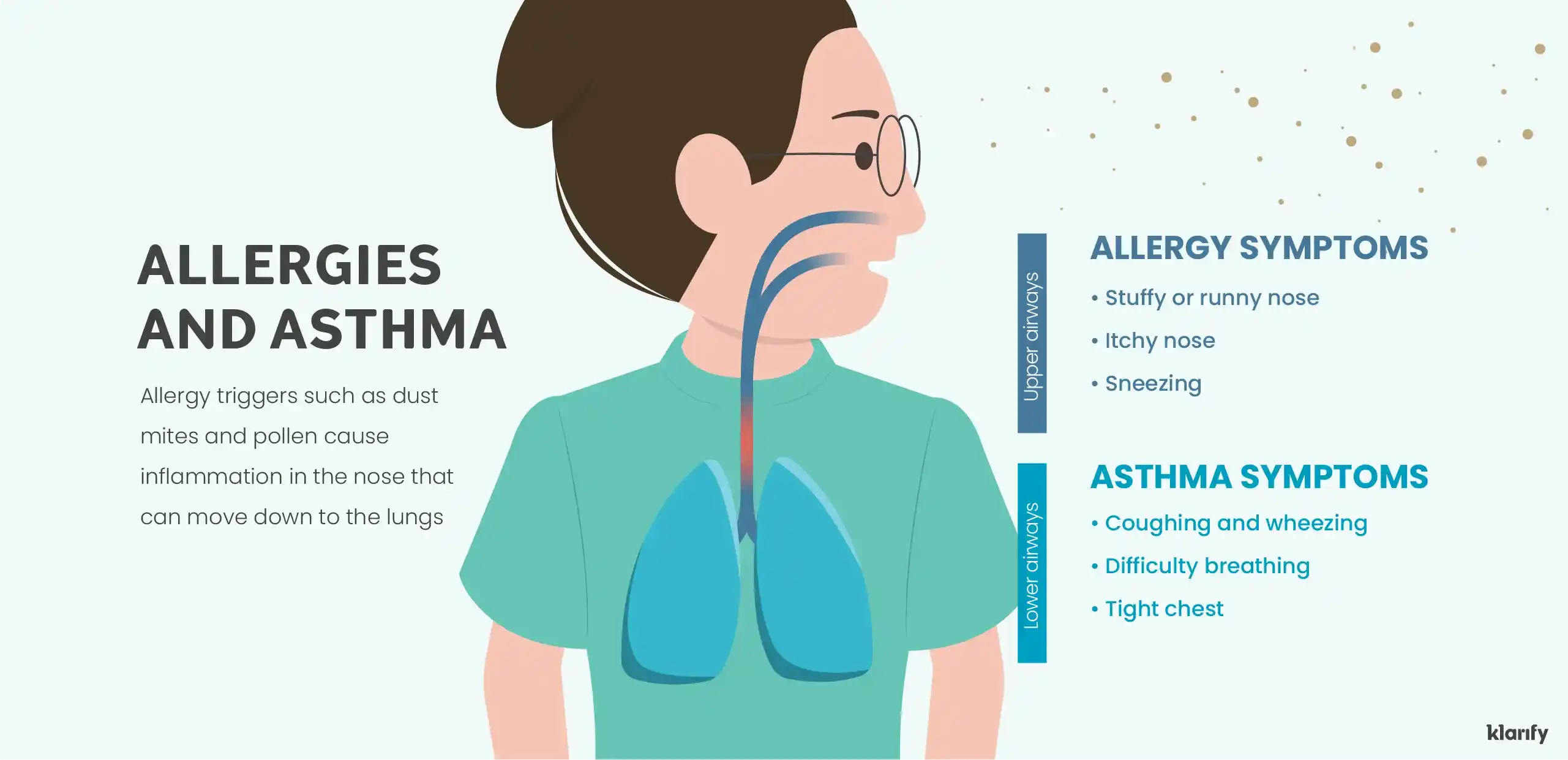
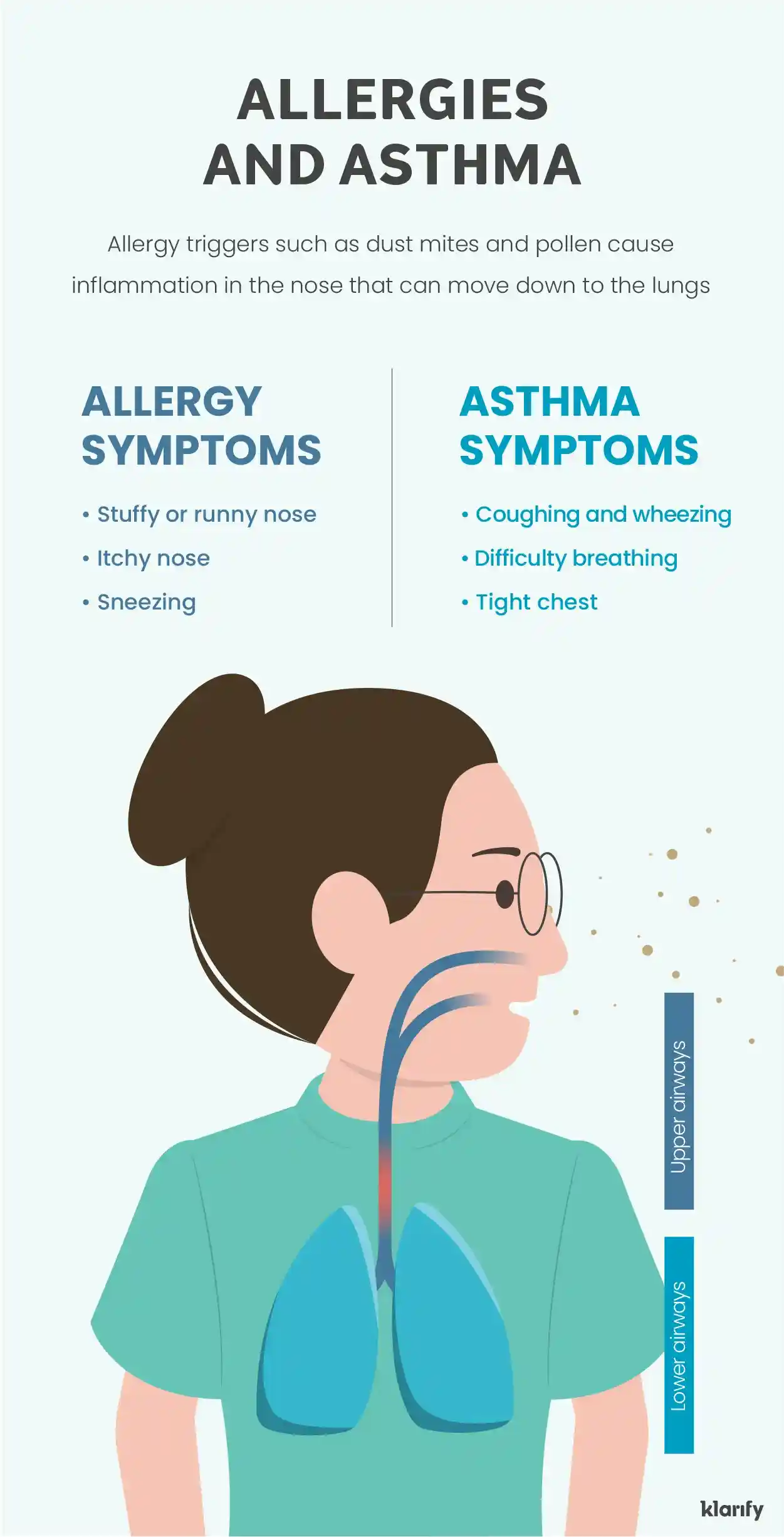
Allergic asthma is a type of asthma triggered when the immune system overreacts to allergens such as dust mites, pollen, pet dander, mould or food.1,2,3 Allergen exposure causes inflammation in the airways, including the bronchial tubes. This can lead to airway narrowing, mucus production, wheezing, coughing, shortness of breath and chest tightness.3 Allergic asthma is linked to allergic rhinitis, eczema and a personal or family history of allergy (atopy).4
Atopy or the genetic predisposition to develop allergies is present in most children with asthma over the age of 3 years old and allergy is the biggest risk factor for developing asthma, according to the National Institute for Health and Care Excellence (NICE).4 Government figures put the number of people over the age of 6 diagnosed with asthma at almost 3.9m or 6.5% of the UK population (2023/24).5 Allergic asthma usually shows itself by the age of 6 but you can develop it at any time.6 Testing for allergy and asthma can help you get a diagnosis and advice on how to manage both conditions, including a personalised asthma action plan (PAAP).
When are allergies most likely to cause asthma?
Allergies are most likely to cause asthma soon after allergen exposure, often within minutes although some people also develop a late-phase reaction several hours later.7 During this process, allergens can trigger airway inflammation, bronchospasm and airway narrowing,7 which may lead to wheezing, coughing, shortness of breath and chest tightness. Common triggers include dust mite allergens, pollen and pet dander, according to Allergy UK.2
- Dust mite allergy: Symptoms are often worst at night or in the morning because dust mite allergens collect in mattresses, pillows and bedding. Upholstered furniture and carpets are also dust mite hotspots, especially in humid indoor environments.8
- Hay fever (pollen allergy): Asthma symptoms may worsen when pollen counts are high. Tree pollen, grass pollen and weed pollen peak at different times of year so allergic asthma can follow a seasonal pattern.8

- Pet allergy: Pet dander, saliva and urine proteins can trigger asthma.2,9 These allergens can linger in homes and spread on pet-owners’ clothing into public spaces, where they readily become airborne to be inhaled.9
What are the allergic asthma signs and symptoms?
Allergic asthma signs and symptoms are variable and may include feeling breathless, coughing, chest tightness and a wheezing or whistling sound when you breathe out.1 It might be worse at night or early in the morning10 and come with allergy symptoms like itchy eyes or a runny nose.8
Symptoms of allergic asthma are sometimes called bronchial allergy symptoms. This is because they affect your bronchial tubes, which are the airways leading to and inside your lungs. The name asthma comes from the ancient Greek word for panting, says ‘Symptoms and Causes of Asthma’ (Journal of Respiratory Medicine, 2021).10
Feeling breathless
Feeling breathless happens because the bronchial tubes tighten until it’s like sucking air through a straw. Breathing out is usually harder than in, at least to start with, and it can be scary.11 Try not to panic and use your asthma inhaler, as prescribed.2
Chest tightness or chest pain
Chest tightness from allergic asthma is caused by the inflammation in your airways and can feel like a band tightening or a weight pressing on your chest.6,12 If there’s chest pain, it can range from a dull ache to a sharp stabbing sensation if the tightness is severe.12

Wheezing
Allergic wheezing is a high-pitched whistling sound when you breathe out. It happens because tubes leading from your lungs are narrower than they should be because of inflammation so the air pressure builds up in the tightened spaces, just like when you blow into a whistle.13,14
People with asthma may find they wheeze more just before bedtime and after waking up (presuming symptoms weren’t bad enough to wake them up). Night-time changes caused by your body clock, plus the effect of sleep, means more pressure is needed to push air out of your lungs.14
It’s also possible to have allergic asthma without any wheezing.12
Coughing
An allergic asthma cough can produce mucus or phlegm or it can be a dry cough.6,12 An allergy cough linked to allergic rhinitis (hay fever), without any asthma symptoms, is usually a dry cough.15
Can any type of allergy trigger asthma?
It’s Type I allergies like pollen, animal dander, dust mites and mould that can trigger asthma.2,3 Allergic asthma is often a later step in a journey known as the allergic march, which typically shows itself as eczema (atopic dermatitis) in babies, food allergies in toddlers and younger children, and then respiratory allergy and allergic rhinitis (hay fever).16
Worldwide, about 49% of people with asthma have allergic rhinitis, according to the study ‘Global Burden of Asthma, and Its Impact on Specific Subgroups: Nasal Polyps, Allergic Rhinitis, Severe Asthma, Eosinophilic Asthma’ (Journal of Asthma and Allergy, October 2023).17
In a Type I allergy your immune system produces Immunoglobulin E (IgE) antibodies. These are primed to respond to your specific trigger and start the allergic reaction when they detect it, explains the British Society for Immunology.3 Exposure to your allergy trigger is also likely to make your allergic asthma symptoms flare up. For example, if you have hay fever, then pollen is likely to affect your asthma.2
Of course, there are other asthma triggers besides allergy.
What are the other asthma triggers besides allergy?
Other things that can trigger asthma include: 2
- Smoke and other kinds of air pollution
- Exercise
- Weather changes
- Infections like colds and flu
- Stress and other emotions
- Alcohol
- Some medications and recreational drugs
- Certain occupations
How do you test for allergic asthma?
The most common ways to test for asthma are spirometry (also called lung function or breath test), peak flow tests, FeNO tests and blood eosinophil tests.18 You may also have allergy tests to see if that could be contributing to your asthma and to find out what you could be allergic to.11
- Blood test: This measures the level of eosinophils, a type of white blood cell, which is raised in people with asthma7,18
- Spirometry test: This involves breathing out into a machine that measures how fast you can exhale and how much air you can hold in your lungs19
- FeNO test: This measures the level of nitric oxide in your breath and shows your doctor whether there is inflammation in your airways20
- Peak flow test: This also measures how fast you can breathe out18

What are the treatment options for allergic asthma?
Treatment options for allergic asthma typically involve addressing both the asthma and your allergies. The doctor may prescribe one or more asthma inhalers and suggest short-term medications such as a corticosteroid nasal spray or an antihistamine for related allergy symptoms.2,8 Allergy immunotherapy can be a long-term solution to tackle the cause of the allergies and reduce asthma symptoms, depending on your eligibility and trigger, says the National Institute for Health and Care Excellence (NICE).21
Asthma medications
The right asthma medication usually involves an inhaled corticosteroid, possibly with another drug depending on symptom severity. An anti-inflammatory reliever inhaler (AIR) relaxes the muscles of the airways going into the lungs when you have asthma symptoms and makes breathing easier again.2,10 A preventer inhaler reduces ongoing inflammation in someone who is highly symptomatic. Maintenance and reliever therapy combines both actions in one inhaler.2,10,22 Inhalers can work in several different ways and the doctor will show you how to use yours correctly.
Leukotriene modifiers are another treatment option for ongoing asthma control and prevention (as well as for allergic rhinitis), especially for people who prefer oral medication or want to avoid some side effects of steroids.23 Specialist clinics may also offer omalizumab for confirmed IgE-mediated allergic asthma that remains uncontrolled despite maximum doses of standard inhalers. Omalizumab is a monoclonal antibody that blocks the IgE immune response driving airway inflammation.8,21
Tackling allergic asthma by managing your allergies
The usual way to manage pollen, dust mite, pet or mould allergy symptoms is by avoiding your trigger, taking short-term relief like antihistamines and corticosteroids and possibly following a course of allergy immunotherapy to retrain your immune system, if that’s what your doctor recommends.24
Antihistamines and corticosteroids come in topical and oral forms. The right one for you will depend on how severe and widespread your symptoms are and any effect is temporary. Allergy immunotherapy involves repeated controlled doses of the substance you’re allergic to. The idea is your body stops seeing it as a threat and that the effect lasts after treatment ends. Eligibility will depend on your age or your child’s if they’re the one with allergies, the particular trigger and your medical history.24
Can allergic asthma develop in kids?
Allergic asthma is common in kids. Children who had severe atopic dermatitis as babies are at highest risk although others can get it too. Your child’s experience of asthma will depend on what age they are as their symptoms and triggers can change over time, as described in ‘Current Insights into Atopic March’ (Children [Basel], November 2021).16

FAQs about allergy and asthma
Allergic asthma is a complicated topic and you’re bound to have more questions. Read our FAQ section below to find quick answers to the most common queries.
Can you cure allergic asthma?
Asthma is a chronic illness and regular asthma and allergy medication like corticosteroids and antihistamines can help control symptoms short term.22,24 Allergy immunotherapy treatment aims to make your body less sensitive to the things that trigger your allergies so may also reduce asthma symptoms after contact with the allergen.3,21
How long does allergic asthma last?
Allergic asthma is often a life-long condition although asthma symptoms can go away on their own, especially in children and teenagers, says the NHS.25 Transient wheeze means it starts before the age of 3 and is gone by 6 years old. Asthma can also go into remission, with symptoms reducing or disappearing temporarily, at a rate of 16-60% by early adulthood.6
Is allergic asthma dangerous?
Asthma symptoms should not cause problems if well controlled but an asthma attack can be life-threatening. Sit upright and use your inhaler, following the instructions in your personalised asthma asthma plan or the information sheet for the medication. Call an ambulance if you don’t feel an improvement and symptoms are still severe. In hospital you can receive oxygen and stronger medication.21
Can allergies affect your breathing?
Allergies can give you a stuffy nose, which can cause difficulty breathing.8 And if your allergies trigger asthma, then you may wheeze or feel breathless.1 During an asthma attack, it might be hard to speak or eat. You might notice rapid breathing and struggle to catch your breath.12
Can treating allergies help prevent allergic asthma?
Prompt diagnosis and getting allergies under control may help lower the risk of allergic asthma developing. Short-term allergy symptom relief includes antihistamines and corticosteroids, while immunotherapy aims for lasting effect.23
The short version
It’s quite common for allergies to trigger asthma, especially if you’re allergic to substances that can be carried in the air, such as dust mites, mould, pollen or pet dander.1,2 Allergic asthma tends to show itself first before the age of 6.6 Symptoms can include chest tightness, a wheezing sound, coughing and shortness of breath. 1 They tend to start within hours or minutes of being exposed to your allergen.7
If you or your child are diagnosed with allergic asthma, you may need an inhaler and short-term allergy relief to manage the range of symptoms.22,24 Managing seasonal allergies in children can also help lower the risk of developing allergic asthma in the future.24 Ask your doctor to tell you more.
klarify takes allergy science and makes it simple, and we have rigorous process for doing this. We use up-to-date and authoritative sources of information. Medical experts review our content before we share it with you. They and the klarify editorial team strive to be accurate, thorough, clear and objective at all times. Our editorial policy explains exactly how we do this.
References
1. NICE. Asthma: What is it? Retrieved 26 May 2026.
https://cks.nice.org.uk/topics/asthma/background-information/definition/
2. Allergy UK. Your quick guide to asthma. Retrieved 26 May 2026.
https://www.allergyuk.org/wp-content/uploads/2022/06/Asthma-V4.pdf
3. British Society for Immunology. Allergy. Retrieved 26 May 2026.
https://www.immunology.org/policy-and-public-affairs/briefings-and-position-statements/allergy
4. NICE. Asthma: What are the risk factors and triggers for asthma? Retrieved 26 May 2026.
https://cks.nice.org.uk/topics/asthma/background-information/risk-factors-triggers/
5. NICE. Asthma: How common is it? Retrieved 26 May 2026.
https://cks.nice.org.uk/topics/asthma/background-information/prevalence/
6. Trivedi M, Denton E. Asthma in Children and Adults. What Are the Differences and What Can They Tell us About Asthma? Front Pediatr. 2019;7:256. Published 2019 Jun 25. doi:10.3389/fped.2019.00256.
https://www.ncbi.nlm.nih.gov/pmc/articles/PMC6603154/
7. Salyer SW. Essential Emergency Medicine, Chapter 15 - Pulmonary Emergencies, 2007, Pages 844-913. doi.org/10.1016/B978-141602971-7.10015-7.
https://www.sciencedirect.com/science/article/pii/B9781416029717100157
8. Bousquet J, Khaltaev N, Cruz AA, et al; World Health Organization; GA(2)LEN; AllerGen. Allergic Rhinitis and its Impact on Asthma (ARIA) 2008 update. Allergy. 2008 Apr;63 Suppl 86:8-160. doi: 10.1111/j.1398-9995.2007.01620.x.
https://onlinelibrary.wiley.com/doi/10.1111/j.1398-9995.2007.01620.x
9. Allergy UK. Pet/animal allergy. Retrieved 26 May 2026.
https://www.allergyuk.org/wp-content/uploads/2021/10/Pet-Allergy.pdf
10. Kader AR. Symptoms and Causes of Asthma. J Respir Med 2021 3:117.
https://www.omicsonline.org/open-access/symptoms-and-causes-of-asthma-118107.html
11. InformedHealth.org [Internet]. Cologne, Germany: Institute for Quality and Efficiency in Health Care (IQWiG); 2006-. Asthma: Symptoms and diagnosis. 2008 Jan 14 [Updated 2017 Nov 30].
https://www.ncbi.nlm.nih.gov/books/NBK279521/
12. Asthma and Lung UK. Symptoms of asthma. Retrieved 27 May 2026.
https://www.asthmaandlung.org.uk/conditions/asthma/symptoms-asthma
13. Gong H JR. Wheezing and Asthma. In: Walker HK, Hall WD, Hurst JW, editors. Clinical Methods: The History, Physical, and Laboratory Examinations. 3rd edition. Boston: Butterworths; 1990. Chapter 37.
https://www.ncbi.nlm.nih.gov/books/NBK358/
14. Scheer FAJL, Hilton MF, Evoniuk HL, et al. The endogenous circadian system worsens asthma at night independent of sleep and other daily behavioral or environmental cycles. Proc Natl Acad Sci U S A. 2021;118(37):e2018486118. doi:10.1073/pnas.2018486118.
https://www.ncbi.nlm.nih.gov/pmc/articles/PMC8449316/
15. Giri S. Allergic rhinitis. InnovAiT. 2023;17:84 - 87. doi:10.1177/17557380231212643.
https://journals.sagepub.com/doi/10.1177/17557380231212643
16. Tsuge M, Ikeda M, Matsumoto N, Yorifuji T, Tsukahara H. Current Insights into Atopic March. Children (Basel). 2021;8(11):1067. Published 2021 Nov 19. doi:10.3390/children8111067.
https://pubmed.ncbi.nlm.nih.gov/34828780/
17. Rabe APJ, Loke WJ, Gurjar K, Brackley A, Lucero-Prisno III DE. Global Burden of Asthma, and Its Impact on Specific Subgroups: Nasal Polyps, Allergic Rhinitis, Severe Asthma, Eosinophilic Asthma. J Asthma Allergy. 2023;16:1097-1113. doi:10.2147/JAA.S418145.
https://www.dovepress.com/global-burden-of-asthma-and-its-impact-on-specific-subgroups-nasal-pol-peer-reviewed-fulltext-article-JAA
18. Asthma and Lung UK. Diagnosing asthma. Retrieved 27 May 2026.
https://www.asthmaandlung.org.uk/conditions/asthma/diagnosing-asthma
19. Asthma and Lung UK. Spirometry and bronchodilator reversibility test. Retrieved 27 May 2026.
https://www.asthmaandlung.org.uk/symptoms-tests-treatments/tests/spirometry
20. Asthma and Lung UK. What is a FeNO test? Retrieved 27 May 2026.
https://www.asthmaandlung.org.uk/symptoms-tests-treatments/tests/feno-test
21. NICE. Antihistamines, allergen immunotherapy and allergic emergencies. Retrieved 28 May 2026.
https://bnf.nice.org.uk/treatment-summaries/antihistamines-allergen-immunotherapy-and-allergic-emergencies/
22. NICE. Asthma. Scenario: Newly-diagnosed asthma and optimising treatment. Retrieved 28 May 2026.
https://cks.nice.org.uk/topics/asthma/management/newly-diagnosed-asthma-optimizing-treatment/
23. Choi J, Azmat CE. Leukotriene Receptor Antagonists. [Updated 2023 Jun 4]. In: StatPearls [Internet]. Treasure Island (FL): StatPearls Publishing; 2024 Jan-.
https://www.ncbi.nlm.nih.gov/books/NBK554445/
24. NICE. Allergic rhinitis. Scenario: Management. Retrieved 28 May 2026.
https://cks.nice.org.uk/topics/allergic-rhinitis/management/management/
25. NHS. Asthma: Diagnosis. Retrieved 27 May 2026.
https://www.nhs.uk/conditions/asthma/diagnosis/
GB-NPR-2600072 Jul. 2026