An allergy resource by

An allergy resource by

Antihistamines: Uses, types, side effects and more
Table of contents:
Table of contents:


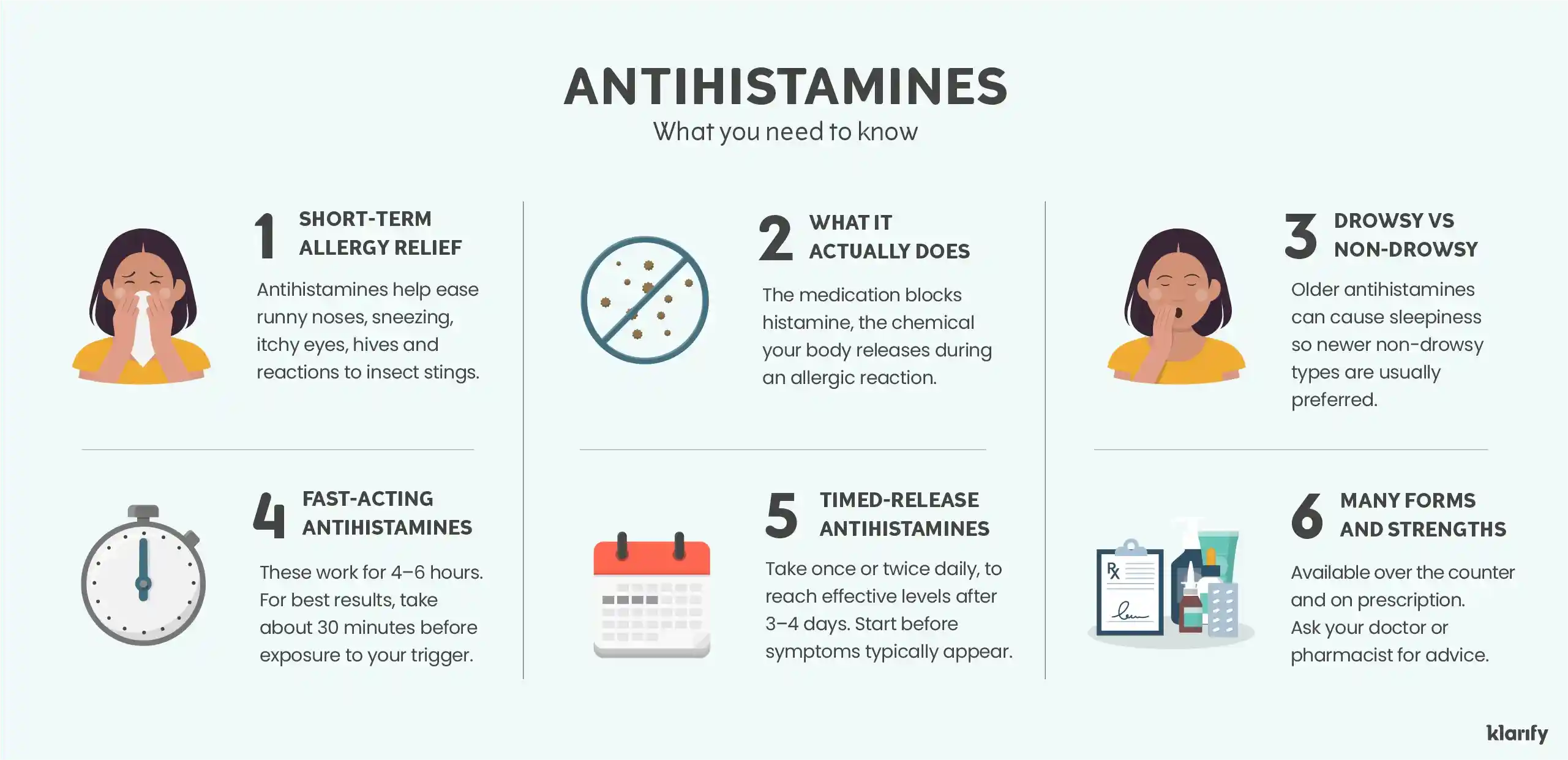
Antihistamines are medications widely used to treat allergic conditions such as hay fever, hives and conjunctivitis. Antihistamines help prevent and relieve sneezing, itching, a runny nose, watery eyes and other symptoms caused by histamine release during an allergic reaction. These medications come in oral and topical forms, and newer non-sedating types are generally preferred over sedating antihistamines because of their lower risk of drowsiness.1
Intranasal and oral antihistamines are among the first line treatments for allergic rhinitis (hay fever), as an alternative to intranasal corticosteroids. Pollen allergy symptoms are usually treated with an over-the-counter antihistamine, according to the National Institute for Care and Health Excellence (NICE). The same medication may be available on prescription for long-term or perennial rhinitis, triggered by indoor allergens like dust mites and pets.2 Antihistamine eye drops are a preferred option for allergic conjunctivitis.2,3
Antihistamines can cause side effects apart from drowsiness. This is much less common with second generation types, which may give you a dry mouth, headache or nausea, depending on the specific medicine, dose and individual circumstances. Newer antihistamines are generally safe for young children, pregnant mothers and the elderly, but ask your doctor for advice.1

How do antihistamines work?
Antihistamines work mainly by binding to histamine receptors in cells around your body and blocking the histamine-driven response from your immune system when it detects an allergy trigger like pollen or dust mites.1,4 Antihistamine can reduce many of the typical allergy symptoms that are the result of histamine:1
- Itchy nose and sneezing:5 Antihistamines block histamine from stimulating nerve endings in the nose, reducing the neural signals that trigger the sneeze reflex and nasal itch.
- Runny nose:5 Antihistamine limits the allergic inflammation that causes blood vessels in the nose to dilate and become leaky and stimulates the production of watery mucus./li>
- Itchy, red, watery eyes:4 Antihistamine blocks H1 receptors in cells in the eye surface and lining of the eyelid (conjunctiva), lessening pruritus, erythema and tearing.
- Hives and swelling:4 Antihistamines reduce the number, size, itchiness and duration of wheals and flares (urticaria) and calm swelling (angioedema) by stabilising histamine receptors in the skin in the inactive state.
- Diarrhoea, abdominal pain, bloating, nausea:6 Antihistamine can block histamine released by mast cells in the gut lining from causing increased intestinal permeability, thus reducing these food allergy symptoms.
Antihistamines for allergy mainly target H1 histamine receptors and can help prevent as well as relieve allergy symptoms. Other antihistamines block H2 receptors.7
H1 and H2 antihistamines: What's the difference?
The difference between H1 antihistamines for allergy and H2 antihistamines for gastric conditions is the type of histamine receptor they act on and where those receptors are in the body. ‘The Role of Histamine and Histamine Receptors in Mast Cell-Mediated Allergy and Inflammation: The Hunt for New Therapeutic Targets’ (Frontiers in Immunology, August 2018) explains:7
- H1 receptors are found in airways, blood vessels, nerves, skin and immune cells, where they play a key role in immediate hypersensitivity reactions. Activation by histamine triggers specific physiological changes, which you may experience as hay fever (allergic rhinitis), pink eye (allergic conjunctivitis) or hives (urticaria). H1 receptors can also amplify allergic inflammation by recruiting other immune cells to the reaction site.7
- H2 receptors are involved in regulating stomach acid secretion, among other roles around the body like calming immune responses. H2 antihistamines tend to target receptors in the stomach to treat acid reflux, peptic ulcers and other gastrointestinal disorders.7
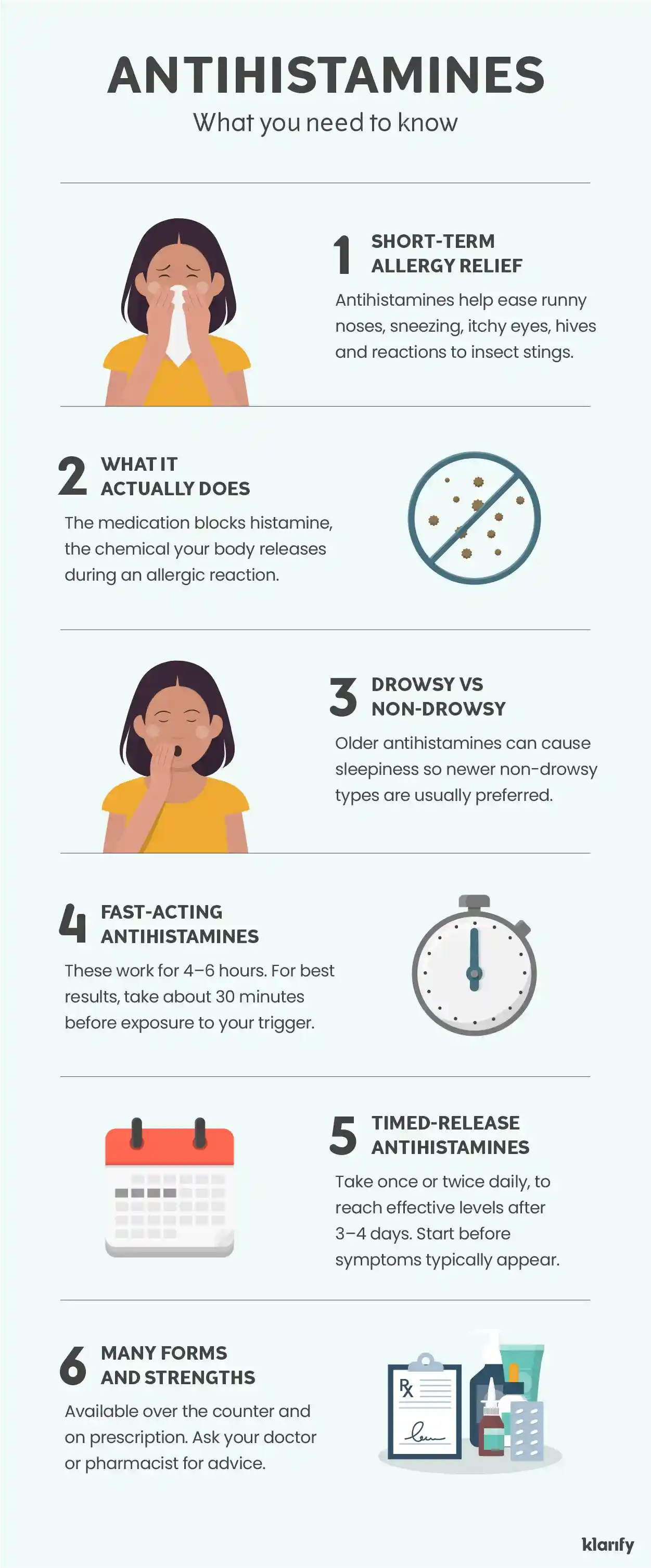
How does antihistamine fit into an allergy treatment plan?
Antihistamines play a vital role in how the NHS manages allergies, alongside avoidance (prevention) and addressing the root cause of the condition. A typical allergy treatment plan might look like this:8
1. Reducing the exposure to allergens: The common first step is taking practical steps like hot-washing bedding weekly to reduce dust mites or keeping windows closed during high pollen counts (see the klarify pollen forecast), depending on your trigger.2
2. Taking short-term relief medications: Antihistamines (and corticosteroids) can help reduce symptoms if taken before exposure and ease them if practical measures don’t work well enough.1,2 Oral forms may be preferred for widespread symptoms, and topical antihistamines for rapid, targeted relief of nasal or ocular symptoms.9
3. Retraining the immune system: Allergen immunotherapy (AIT) tablets, drops or injections may be an option, depending on your age, eligibility and allergy. This is a course of treatment (also known as desensitisation) that aims to reduce symptoms by inducing lasting tolerance to the allergen.2 Allergy immunotherapy is available for allergies to tree and grass pollen, dust mites, pet dander and insect venom.10
Your GP or allergy specialist is likely to review the plan if symptoms persist after 2-4 weeks despite following step 1 and 2.2 Antihistamines come in different forms or strengths of antihistamine to try. Most are available over the counter but some are prescription-only if you need a stronger form.1
Can antihistamines prevent allergy symptoms?
Yes, antihistamines may help prevent allergy symptoms if you take them before contact with the allergen and continue regularly during exposure. If you have hay fever, ask the doctor how long before pollen season to begin antihistamines and to build up protective levels in your body. It could take up 3-4 days, depending on the type of antihistamine.11
The preventative effect of so-called symptomatic medications like antihistamine and corticosteroids is temporary. The only treatment option that aims to prevent or reduce symptoms in the long term is allergy immunotherapy, which works by tackling the root cause of the reaction.2
Did you know...?
- John Bostock described allergic rhinitis in 1819 (he’d had symptoms since the age of 8) and the name hay fever emerged a decade later.12
- Early cures tried ranged from cold baths to purging and blisters, even digitalis, mercury and opium.12
- The first substance with antihistamine properties was discovered in 1937 by scientist Daniel Bovet; he won a Nobel prize for this and other work.13
- The first antihistamine drug was ready to test in humans in 1942.13
- Early uses included treating nausea (in pregnancy, due to anaesthesia, motion sickness), the common cold and flu.13
- Now, antihistamines can help stomach problems10, anxiety13 and even long-COVID.14
What are the different types of antihistamines?
Antihistamines are typically classified into first-generation (sedating) and second-generation (non-sedating) types, with a third generation derived from certain second-generation drugs. The different types of antihistamines affect the brain and body differently.15
First-generation antihistamines
Older, first-generation antihistamines can make you feel sleepy and usually carry labels warning against driving or operating heavy machinery after taking them.15 Guidelines now recommend against prescribing these sedating antihistamines, except where sedation is helpful such as short-term treatment of insect stings and for chronic pruritus (itching).16,17
First-generation antihistamines include:1
- Chlorphenamine
- Promethazine
- Hydroxyzine
- Cinnarizine
Second-generation antihistamines
Newer generation antihistamines selectively target H1 receptors in the skin, lungs and blood vessels but outside the central nervous system (peripheral). They do not cross the blood-brain barrier which minimises side effects such as sedation and cognitive impairment common with first-generation antihistamines. They are often labelled non-drowsy.15
Second-generation antihistamines include:
- Cetirizine1
- Loratadine1
- Acrivastine1
- Bilastine10
- Mizolastine10
Third-generation antihistamines
Third-generation antihistamines are derived from second-generation types but they work faster (within 30 minutes, instead of at least an hour) and have additional anti-inflammatory properties. There are fewer side effects and interactions with other drugs, according to ‘Evolution, Mechanism of Action and Clinical Applications of Three Generations of Antihistamines’ (Innovaciencia, August 2024).15
Third-generation antihistamines include:15
- Fexofenadine
- Levocetirizine
- Desloratadine

Oral vs topical antihistamines?
Oral antihistamines are often preferred for multiple, widespread or severe symptoms, while topical antihistamines can offer rapid targeted relief for nasal or for eye symptoms. Your doctor will be able to advise you on your options.
| Form | Good for | Onset | Side effects | Why use |
|---|---|---|---|---|
| Oral antihistamines: Tablets, capsules, liquids, syrups1 | A first-line option to treat allergic rhinitis (hay fever symptoms).2May be combined
with a leukotriene modifier for
better daytime or nighttime symptom control, depending on the
antihistamine18 First-line treatment for urticaria (hives)19 Adjunctive (secondary) treatment for severe systemic allergic reactions, anaphylaxis, and asthma4,10 |
30 minutes – 3 hours, depending on the specific antihistamine15 | First generation types can cause drowsiness, reduced co-ordination, reaction speed and judgement,
dry mouth, urinary
retention and blurred
vision1 Second generation antihistamines can cause headaches, dry mouth, nausea, but usually minimal drowsiness1 |
Broad symptom coverage and convenience, possibly user preference over topical forms |
| Intranasal antihistamines: nasal sprays | For moderate-to-severe allergic rhinitis, when rapid relief is needed and/or oral antihistamine is ineffective2 Combined with intranasal corticosteroid when antihistamine alone is insufficient2,9 |
15-30 minutes9 | Bitter taste if used incorrectly, irritation of nasal mucosa9 | Fast onset, local action, systemic side effects uncommon2,9 |
| Ocular antihistamines: eye drops | Many modern antihistamine eye drops also have mast cell stabilising properties so can stifle the initial immune response while blocking the effect of histamine.3Drops are preferred for treating for allergic conjunctivitis as antihistamines are more likely to exacerbate dry eye syndrome.19They can often relieve nasal symptoms | 3-15 minutes20 | Eye irritation, bitter taste21 |
What is antihistamine combination therapy?
Antihistamine combination therapy is when another medication is taken with the oral or topical antihistamine to provide more effective allergy relief than either one on its own. The specific combination depends on your main symptoms and how you’ve responded to previous treatments.
Three medications routinely combined with antihistamine and one drug-free remedy are listed below.
1. Corticosteroids: Combined antihistamine and corticosteroid nasal spray can be even more effective than intranasal corticosteroid, the preferred first-line treatment for allergic rhinitis, rapidly relieving eye as well as nasal symptoms.2 This was the finding of ‘Effects of H1 Antihistamine Addition to Intranasal Corticosteroid for Alergic Rhinitis: A Systematic Review and Meta-analysis’ (International Forum of Allergy & Rhinology, June 2018). Oral antihistamine does not offer the same benefits combined with corticosteroid spray.22
2. Leukotriene receptor antagonists: Combined oral antihistamine and leukotriene modifier therapy is most appropriate for persistent, multi-dimensional or difficult to control allergic rhinitis. Different antihistamines are more effective, in the combination, for nasal obstruction, sneezing and itching, or nasal discharge, and daytime versus nighttime symptoms. This is the finding of ‘Montelukast and Antihistamines in Allergic Rhinitis: A Systematic Review and Network Meta-Analysis’ (Allergy, Asthma & Immunology Research, November 2025). The combined therapy does not seem to be of particular value with eye symptoms.18
3. Decongestants: Combined oral medications often have a -D at the end of the name, indicating it contains a decongestant to opens blocked airways by shrinking swollen blood vessels in your nose, while antihistamines deal with the itchiness and sneezing.1,23 Topical decongestants are also available but should only be used for short periods or may make symptoms worse again.23
4. Saline: Using a hypertonic saline nasal spray or drops alongside antihistamines for allergic rhinitis can improve symptom control and quality of life, and reduce the need for antihistamine. This is according to ‘The Role of Saline Nasal Sprays or Drops in Nasal Hygiene: A Review of the Evidence and Clinical Perspectives’ (Rhinology Online, January 2021). Clear the nasal passages with saline first, then use the antihistamine after a short interval.24

Who can take antihistamines?
Most people can take antihistamines safely but you should talk your GP or the pharmacist before giving a child any medication to make sure you get the appropriate type for their age and weight. The antihistamine preferred during pregnancy is Loratadine, according to the NHS, and loratadine and cetirizine while breastfeeding but please seek advice about your specific allergy symptoms first. The same applies if you are older, take other medication or have any underlying health conditions.1
Always read the information leaflet for your medication carefully. If it’s an oral antihistamine, does it have to be taken with water or food? How many times a day and how long can for – some antihistamines are only recommended for a few days at a time. What are the side effects to watch out for? 1
What are the side effects of antihistamines?
Antihistamines can cause side effects, like any medication, and these differ depending on the type, first or second-generation, oral or topical.
Side effects to older, first-generation oral antihistamines could be:
- Drowsiness, poor co-ordination and reduced reaction speed and judgement. Hence the risk in driving or using machinery1,2
- Dry mouth1,2
- Blurred vision1,2
- Postural hypotension and dizziness4
- Trouble peeing and constipation 1,2
- Appetite stimulation and weight gain4
Side effects of second-generation oral antihistamines could be:
- Headache1
- Dry mouth1
- Nausea1
- Drowsiness, but it is much less common for these newer antihistamines to make you sleepy 1,2
Side effects of topical antihistamines could be:
- Local irritation in the nose or eyes
- Bitter taste
If you experience side effects, report these to your doctor, who may suggest an alternative treatment.
The short version
Antihistamines are medicines used to relieve allergy symptoms such as hay fever, hives and allergic conjunctivitis. They work by blocking the effects of histamine, released by the immune system during an allergic reaction. First-generation antihistamines are more likely to cause drowsiness and other side effects, while newer second- and third-generation drugs are usually less sedating and are preferred. Antihistamines can be taken orally or topically, as nasal sprays or eye drops, depending on where symptoms are felt most strongly.1 Sometimes they are more effective used in combination with other allergy relief like corticosteroids, decongestants, leukotriene modifiers or saline.15,22,23,24 The effect will be short-term so the next step in the treatment plan may be allergy immunotherapy to tackle the root cause of the disease.2
Most people can take antihistamines safely but children, pregnant people, older adults and anyone with other conditions or medications should seek advice first. Common side effects include dry mouth, headache, nausea, local irritation and, with older types, drowsiness, reduced coordination and blurred vision.1
Klarify takes allergy science and makes it simple, and we have rigorous process for doing this. We use up-to-date and authoritative sources of information. Medical experts review our content before we share it with you. They and the klarify editorial team strive to be accurate, thorough, clear and objective at all times. Our editorial policy explains exactly how we do this.
References
1. NHS. Antihistamines. Retrieved 14 May 2026.
https://www.nhs.uk/medicines/antihistamines/
2. National Institute for Health and Care Excellence. Allergic rhinitis management. Retrieved 14 May 2026.
https://cks.nice.org.uk/topics/allergic-rhinitis/management/management/
3. National Institute for Health and Care Excellence. Conjunctivitis – allergic: Management in primary care. Retrieved 26 May 2026.
https://cks.nice.org.uk/topics/conjunctivitis-allergic/management/management-in-primary-care/
4. Simons FE, Simons KJ. H1 antihistamines: current status and future directions. World Allergy Organ J. 2008;1(9):145-155. doi:10.1186/1939-4551-1-9-145.
https://pmc.ncbi.nlm.nih.gov/articles/PMC3650962/
5. Nur Husna SM, Tan HT, Md Shukri N, et al. Allergic Rhinitis: A Clinical and Pathophysiological Overview. Front Med (Lausanne). 2022;9:874114. Published 2022 Apr 7. doi:10.3389/fmed.2022.874114.
https://pmc.ncbi.nlm.nih.gov/articles/PMC9021509/
6. Al-Maamari A, Sultan M, Ding S, et al. Mechanisms and implications of histamine-induced reactions and complications. Allergol Immunopathol (Madr). 2025;53(3):122-139. Published 2025 May 1. doi:10.15586/aei.v53i3.1272.
https://all-imm.com/index.php/aei/article/view/1272/1935
7. Thangam EB, Jemima EA, Singh H, et al. The Role of Histamine and Histamine Receptors in Mast Cell-Mediated Allergy and Inflammation: The Hunt for New Therapeutic Targets. Front Immunol. 2018;9:1873. Published 2018 Aug 13. doi:10.3389/fimmu.2018.01873.
https://pmc.ncbi.nlm.nih.gov/articles/PMC6099187/
8. UK Parliament, House of Lords Library. Allergies and the NHS: Allergy prevalence, treatment options and potential improvements to NHS allergy care (In Focus). Published December 2024. Retrieved 15 May 2026.
https://lordslibrary.parliament.uk/allergies-and-the-nhs-allergy-prevalence-treatment-options-and-potential-improvements-to-nhs-allergy-care/
9. Linton S, Hossenbaccus L, Ellis AK. Evidence-based use of antihistamines for treatment of allergic conditions. Ann Allergy Asthma Immunol. 2023;131(4):412-420. doi:10.1016/j.anai.2023.07.019.
https://pubmed.ncbi.nlm.nih.gov/37517656/
10. National Institute for Health and Care Excellence. Antihistamines, allergen immunotherapy and allergic emergencies. Retrieved 15 May 2026.
https://bnf.nice.org.uk/treatment-summaries/antihistamines-allergen-immunotherapy-and-allergic-emergencies/
11. American College of Allergy, Asthma & Immunology. Hay fever. Retrieved 15 July 2026.
https://acaai.org/allergies/allergic-conditions/hay-fever/
12. The Royal College of Physicians. The story of an allergy: coming to understand hay fever. Retrieved 16 May 2026.
https://history.rcp.ac.uk/blog/story-allergy-coming-understand-hay-fever
13. Tiligada E, Ennis M. Histamine pharmacology: from Sir Henry Dale to the 21st century. Br J Pharmacol. 2020;177(3):469-489. doi:10.1111/bph.14524.
https://pmc.ncbi.nlm.nih.gov/articles/PMC7012941/
14. Salvucci F, Codella R, Coppola A, et al. Antihistamines improve cardiovascular manifestations and other symptoms of long-COVID attributed to mast cell activation. Front Cardiovasc Med. 2023;10:1202696. Published 2023 Jul 17. doi:10.3389/fcvm.2023.1202696.
https://pmc.ncbi.nlm.nih.gov/articles/PMC10388239/
15. Lisiecka MZ. Evolution, mechanism of action and clinical application of three generations of antihistamines. Innovaciencia 2024; 12(1); e3651. doi:10.15649/2346075X.3651.
https://www.researchgate.net/publication/383731629
16. National Institute of Health and Care Excellence. Sedating antihistamines. Retrieved 18 May 2026.
https://cks.nice.org.uk/topics/urticaria/prescribing-information/sedating-antihistamines/
17. National Institute of Health and Care Excellence. Topical local antipruritics. Retrieved 18 May 2026.
https://bnf.nice.org.uk/treatment-summaries/topical-local-antipruritics/
18. Kim JS, Stybayeva G, Hwang SH. Efficacy of a Combination Therapy of Montelukast and Antihistamines in Allergic Rhinitis: A Systematic Review and Network Meta-Analysis. Allergy Asthma Immunol Res. 2025;17(6):692-708. doi:10.4168/aair.2025.17.6.692.
https://pubmed.ncbi.nlm.nih.gov/41330702/
19. European Academy of Allergy and Clinical Immunology. Global atlas of allergy. Retrieved 18 May 2026.
https://www.researchgate.net/profile/Matteo-Bonini-2/publication/282321941_Allergic_diseases_and_sport/links/564de79408aefe619b0eb03f/Allergic-diseases-and-sport.pdf
20. Herrero-Vanrell R, Jáuregui Presa I, Leceta Bilbao A, Montero-Iruzubieta J. Fundamental Aspects and Relevance of Components in Antihistamine Eye Drops. J Investig Allergol Clin Immunol 2023; Vol 33(6) : 431-438. doi: 10.18176/jiaci.0963.
https://www.jiaci.org/revistas/vol33issue6_2.pdf
21. National Institute for Health and Care Excellence. Azelastine hydrochloride. Retrieved 19 May 2026.
https://bnf.nice.org.uk/drugs/azelastine-hydrochloride/
22. Seresirikachorn K, Chitsuthipakorn W, Kanjanawasee D, Khattiyawittayakun L, Snidvongs K. Effects of H1-antihistamine addition to intranasal corticosteroid for allergic rhinitis: a systematic review and meta-analysis. Int Forum Allergy Rhinol. 2018;8:1083–1092. doi:10.1002/alr.22166.
https://onlinelibrary.wiley.com/doi/10.1002/alr.22166
23. NHS. Decongestants. Retrieved 19 May 2026.
https://www.nhs.uk/conditions/decongestants/
24. Santoro E, Kalita P, Novak P. The Role of Saline Nasal Sprays or Drops in Nasal Hygiene: A Review of the Evidence and Clinical Perspective. Rhinology Online, 4, 1-16. doi:10.4193/RHINOL/20.072.
https://www.rhinologyonline.org/Rhinology_online_issues/manuscript_102.pdf
GB-NPR-2600073 Jul. 2026