An allergy resource by

An allergy resource by

Allergy testing in the UK: Types, access and next steps
Table of contents:
Table of contents:


Allergy testing is a diagnostic tool used to confirm whether symptoms such as persistent sneezing, a runny nose or a skin rash are part of an allergic reaction. The allergy test looks for evidence of an exaggerated immune response and identifies the trigger (allergen). The most common methods of allergy testing are skin prick tests, specific IgE blood tests, patch tests and oral food challenges, with the appropriate investigation depending on your symptoms and suspected condition.1,2 A doctor or allergy specialist will interpret the results because a positive allergy test does not always mean you have a true clinical allergy.1
Allergen testing can help diagnose a wide range of conditions, such as hay fever (allergic rhinitis), food allergy, insect venom allergy, eczema and allergic asthma. The process usually begins with the GP, who reviews your medical history and symptoms before deciding whether to refer you to an allergist or immunologist for tests. Referral criteria include ongoing or recurring allergy-like symptoms that may be hard to control, an unknown trigger or multiple triggers, or a suspected risk of anaphylaxis.3
Guidelines specify that allergy tests should only be carried out where there are symptoms to confirm or exclude an allergy diagnosis and improve management of the condition, not as routine screening.3 Effective allergy management, guided by proper testing, minimises the burden of allergic symptoms on daily life, productivity and mental wellbeing.4 Identifying and treating childhood allergies promptly may reduce the risk of developing allergic asthma.5
How allergy tests work?
Allergy tests work by looking for evidence that your immune system has reacted to an allergen. Blood tests measure levels of a specific antibody called Immunoglobulin E (IgE), which your immune system produces when it mistakenly identifies a harmless substance as a threat. Skin prick tests, intradermal tests and food and drug challenges expose you to a suspected allergen and monitor your physical reaction for signs of allergy.2,6
Commonly tested allergens include pollen, house dust mites, pet dander, mould, foods such as peanuts, tree nuts, milk and eggs, and insect venom. A positive allergy test result, whether IgE antibodies in the blood or a reaction to a skin or challenge test, means you are sensitised to that substance and may be allergic. Sensitisation does not always develop into a clinical allergy so allergy test results must always be reviewed alongside your clinical history before the doctor or allergy specialist can confirm the diagnosis, says the British Society of Immunology.1

What types of allergy tests are there?
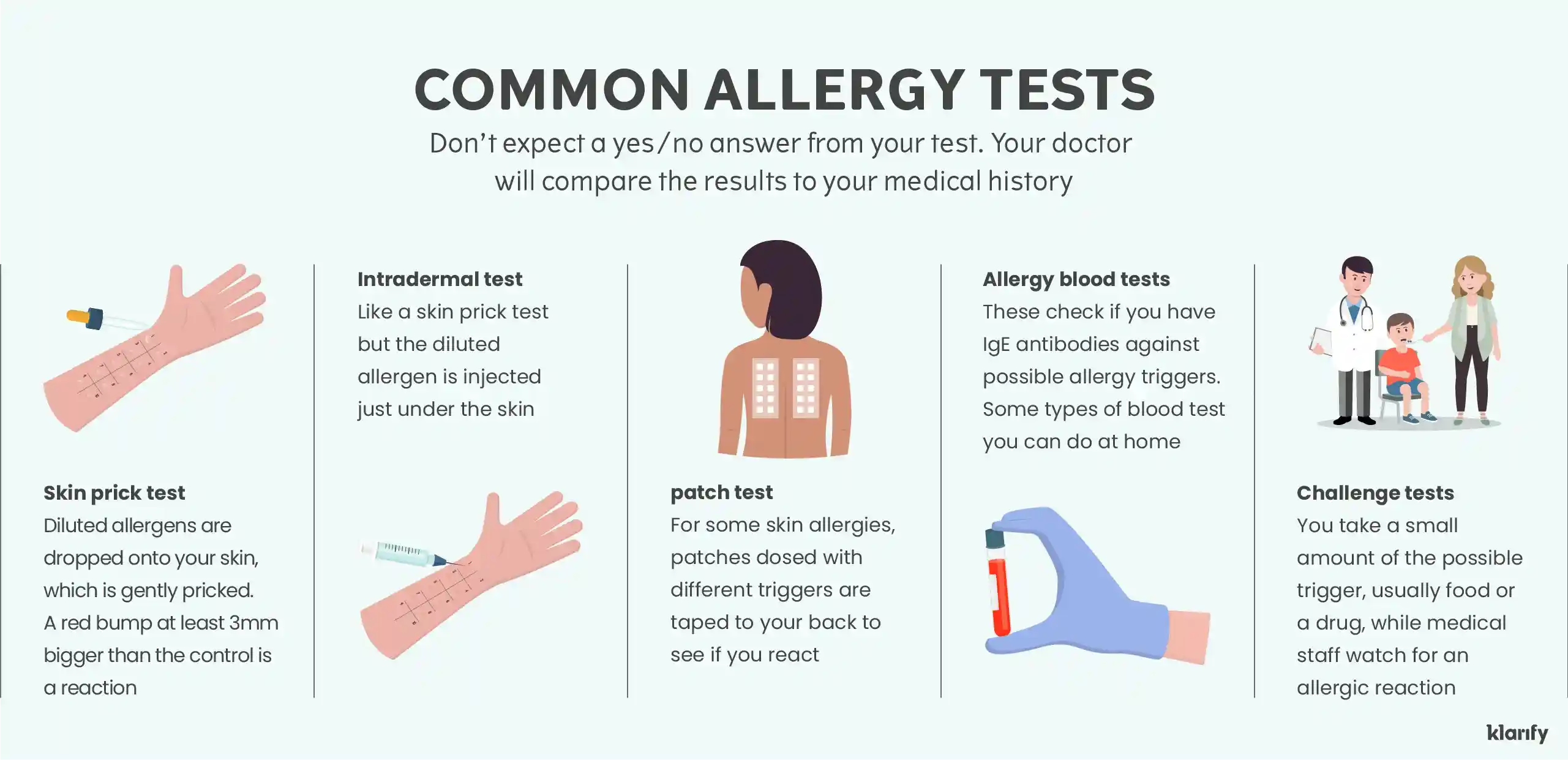
Allergy tests fall into three main types, which are skin tests, blood tests and challenges (provocation tests). Your doctor will tell you which test they recommend and you may need to have more than one if results are unclear.1,2
Allergy skin tests include:
- Skin prick test2
- Intradermal test7
- Patch test2
Allergy blood tests include:2
- Specific IgE blood test
- Component resolved diagnosis
- Home blood test
Provocation tests include:
- Oral food challenge2
- Drug challenge test6
Depending on the type of test, the doctor may ask you to pause allergy medications like antihistamines a few days beforehand.2,8
Skin prick test
Skin prick tests involve medical staff putting a drop of diluted allergen on your skin, often the forearm, and gently pricking the area. One test will cover up to 25 allergens, laid out in a grid, and you may find it mildly uncomfortable.1,6 A positive result is an itchy red swelling (wheal) at least 3mm in diameter that appears around a needle prick after about 15 minutes.8 This shows you are sensitised to that allergen and might be allergic to it.1

Intradermal test
An intradermal test involves injecting dilute allergen just under the skin on your arm to form a bleb 4-6mm in diameter, then checking after 20 minutes. A positive result is if it grows by at least 3mm;7 if negative, the bleb doesn’t grow and disappears in about an hour.6 The intradermal test is more invasive than a skin prick test and carries a greater risk of anaphylaxis. For this reason, it’s used mainly to double-check for insect venom or drug allergies after a negative skin prick test.7
Patch test
Patch tests involve taping small discs carrying potential allergens to your back or upper arm to see if there’s a reaction.9 Medical staff take off the patches to check your skin after 48 hours and again after another 48 hours. Patch tests help identify allergy triggers that cause delayed symptoms through skin contact, which is why the process takes several days. 10 Contact allergens can be chemicals including ingredients in perfumes, toiletries and cosmetics, as well as preservatives, metals and plants.9
Serum-specific IgE blood test
A serum-specific IgE blood test involves giving a small blood sample to be checked for IgE antibodies indicating sensitisation.1 The doctor might suggest an allergy blood test if you have certain skin conditions or can’t pause taking antihistamine, which could interfere with a skin test.8 Your blood sample will go to the lab for analysis so you’ll probably need to return to the clinic for the allergy test results.9
Component resolved diagnosis
Component resolved diagnosis (CRD) is the term for a more detailed blood test, also known as molecular allergy testing, which measures the immune response to individual proteins. CRD is not used routinely but can deepen the understanding of an individual’s allergy because different proteins are linked to different characteristics.11
Children may grow out of food allergies in adolescence or as adults, indicated by a negative CRD result to particular proteins.11 Certain food allergens are closely linked with anaphylaxis, a potentially life-threatening allergic reaction, according to the ‘WAO — ARIA — GA2LEN Consensus Document on Molecular-based Allergy Diagnosis (PAMD@): Update 2020’ (World Allergy Organization Journal, February 2020).12 Others proteins suggest the primary allergy may be pollen and the food symptoms a cross-reaction.11

Home allergy tests
Home allergy tests give you the means to take your own small blood sample, typically by finger prick, and either get instant results or send it to the lab for IgE antibody testing, without waiting for an allergy clinic appointment. The results can give you the confidence to talk to your doctor or allergy specialist, who will interpret the test alongside your symptoms and make a diagnosis.
Avoid home allergy tests that look for IgG antibodies or use bioresonance, both available in the UK according to ‘Issues Surrounding Consumer‐bought Food Allergy Testing (Clinical & Experimental Dermatology, March 2022).13 The British Society of Allergy & Clinical Immunology describes these testing methodologies as ‘not valid diagnostic tests’.14
Oral food challenge
Oral food challenges are the gold standard for diagnosing food allergy, assessing individual tolerance levels for an allergen and testing whether children or adults have grown out of their allergy. The challenge involves eating a small dose of the suspected trigger and increasing it gradually until it causes a reaction. The test takes place under close monitoring in hospital or at the allergy clinic, with medical staff and allergy medication on hand in case of a severe reaction.2,15
Drug challenge test
A drug challenge test or drug provocation test is the gold standard for investigating allergies to medication, typically when other tests are inconclusive. Gradually increasing doses of the drug are administered under close medical supervision. A drug challenge test can cause allergic rash, swelling and anaphylaxis, for which emergency treatment is readily available throughout. When a drug allergy is already diagnosed, the test can act as a safety check for alternative medication. Positive test results are added to hospital and GP records to guide future prescribing.6
Which allergy test is right for you?
The right allergy test depends on the type of allergic reaction and the suspected allergen. Skin prick tests and specific IgE blood tests identify immediate allergies triggered by IgE antibodies, while patch tests diagnose delayed reactions such as contact dermatitis.2 For some allergens, particularly certain drugs, standardised skin test reagents don't exist and a supervised provocation challenge may be needed to confirm or rule out an allergy.6 Component-resolved diagnostics can break down complex allergens into individual proteins, helping to predict reaction severity and guide treatment.11
The sections below cover the most common allergy tests by allergen, including pollen, dust mites, and more.
Pollen allergy tests
The first-line tests for pollen allergy are skin prick tests and specific IgE blood tests to grass, tree or weed pollens. Only a small panel of locally relevant pollens is usually tested, with the results considered alongside seasonal or outdoor symptoms such as sneezing, a blocked or runny nose or itchy eyes.5,16 Component resolved diagnostics can distinguish pollen-related cross-reactions to food from true food allergy.12

House dust mite allergy tests
The first-line tests for house dust mite allergy are skin prick tests and specific IgE blood tests to Dermatophagoides pteronyssinus and Dermatophagoides farinae, the common allergenic mite species.17 Dust mite allergy tests are considered when allergic rhinitis and allergic asthma happen mainly at home and potentially year-round. Component resolved diagnostics can indicate whether someone with dust mite allergy might also experience cross-reactions when eating shrimp.11
Pet allergy tests
The first-line tests for pet allergy are skin prick tests and specific IgE blood tests to identify sensitisation to proteins in animal saliva, dander and urine. Furry pets like cats, dogs and horses are the most likely triggers and can cause allergic rhinitis, wheezing and a tight chest. Pet allergens are carried on clothing and can linger in homes after the animal has gone so contact may not be obvious.18
Mould allergy tests
The first-line tests for mould allergy are skin prick tests and specific IgE blood tests to species such as Alternaria and Cladosporium, typically included within broader inhalant (respiratory) allergen panels.16 Mould extracts are highly variable, unlike standardised pollen and dust mite extracts, which increases the risk of false positive test results. This was the finding of ‘Problems Encountered Using Fungal Extracts as Test Solutions for Fungal Allergy Diagnosis’ (Journal of Fungi, September 2023).19
Food allergy tests
The first-line tests for food allergy are skin prick tests and specific IgE blood tests, with a supervised oral food challenge as the gold standard to clarify inconclusive results.20 Component-resolved diagnostics can test for proteins more likely to cause anaphylaxis, such as Ara h 2 (peanut), Cor a 14 (hazelnut), Ana o 3 (cashew) and Ses i 1 (sesame). Testing positive for Bos d 8 (casein in milk) suggests milk allergy may persist into adulthood.11 Test results are considered alongside food allergy symptoms such as hives, swelling, vomiting, wheeze or anaphylaxis soon after eating.20
Drug allergy tests
The first-line test for drug allergy is a skin prick test, followed by an intradermal test if the first result is negative. A supervised drug provocation test in a medical setting may be necessary, either to confirm or exclude an allergic reaction or because there is no standardised solution or validated test for that particular drug. 6 Symptoms that may call for drug allergy testing include hives, swelling, breathing difficulties or a skin reaction shortly after taking a medicine.21
Latex allergy tests
The first-line tests for Type I (immediate) latex allergy are skin prick tests and latex-specific IgE blood tests, supported by a glove challenge if necessary.22 Latex allergy risks include wearing protective latex gloves and contact with medical devices during multiple surgeries.12,22 Component-resolved diagnostics can help assess the risk of perioperative anaphylaxis, linked to Heb b 1 and Heb b 2, and predict oral symptoms from eating certain fresh fruit that cross-react with latex.12 Patch testing is used for identifying Type IV (delayed) contact allergy triggered by latex.22
Contact allergy test
The first-line test for allergic contact dermatitis is the patch test, interpreted alongside the appearance, timing and distribution of the skin symptoms. Allergic contact dermatitis is a delayed reaction that presents with itchy, eczematous rashes wherever the skin was exposed to the substance. That is most commonly the hands, although airborne allergens can affect the face, neck and body. The undefined margins of an allergic rash can look different to sharp-edged irritant contact dermatitis, helping identify false positive patch test results.23
Can children take the same allergy tests as adults
Yes, children can take most allergy tests that adults have, which means skin prick tests, blood tests and challenges, but testing may be carried out by specialist paediatric allergy services and adjustments may be necessary depending on age. Babies and toddlers will usually be tested against a smaller number of allergens most common in young children.16
- Skin prick tests: Infants may have skin prick tests on the back instead of their forearm to give more space for the grid of allergens and to put itchy wheals out of reach if the result is positive. The reaction tends to be smaller in younger children.16
- Allergy blood test: In vitro serum IgE testing is quicker and needs less co-operation from the child, meaning it is preferable for very young children. High risk of anaphylaxis, unstable medical conditions, certain medications or skin issues can also be reasons for avoiding skin prick tests.16 Children having a specific IgE blood test may be more comfortable with an anaesthetic cream applied beforehand.24
- Oral food challenge: In children challenges may be scheduled when the chance of tolerance is high (based on history and the results of other tests), with the aim of safely reintroducing foods and improving quality of life burdens. This was the finding of ’6829 Oral Food Challenge Outcomes in Children and Adolescents at Oxford University Hospitals NHS Foundation Trust: A 2-year Retrospective Review (Archives of Disease in Childhood 2024).25
Intradermal tests are uncommon in children because of the increased discomfort compared to skin prick tests and higher risk of anaphylaxies.16
How to get an allergy test: GPs, specialists and private clinics
The right route to getting an allergy test depends on your symptoms, budget and how long you're willing to wait.
1. Start with your GP, who can assess your symptoms and identify likely causes. Your personal and family medical history is important, particularly any allergies or asthma.1 Your GP may be able to suggest a treatment plan straight away if your symptoms are mild and the trigger is clear.3 Otherwise they may refer you for further testing, either to an NHS allergy clinic or, for mainly skin symptoms, a dermatologist.3,10 Spirometry testing for allergic asthma may happen at the GP surgery or a specialist clinic.26
2. NHS allergy specialists can carry out a range of tests, including skin prick tests and specific IgE blood tests, to pinpoint specific triggers.3 Waiting times for appointments can be weeks or months, depending on your area.
3. Dermatologists specialise in skin-related allergic conditions such as contact dermatitis or chronic hives. Patch testing is often used in these cases and can be accessed through an NHS referral or privately.10
4. Private allergy clinics can offer faster access than the NHS. Allergy testing may be covered under your health insurance but check your policy or call your insurer before booking as cover varies between providers and plans.
Avoid relying solely on home allergy testing kits. Ask a qualified clinician to interpret your results and advise on next steps.

Is allergy testing safe?
Yes, allergy testing is safe for most people and the risks are well-understood and managed. Skin prick tests and challenges expose you to a potential trigger under medical supervision. A skin prick test result causes a mild allergic reaction if positive and severe reactions are rare. Challenge tests carry a higher risk because the dose of allergen is greater and tends to be either a food or drug, both of which can trigger anaphylaxis. Clinic staff monitor you throughout, ready to treat any reaction quickly. Allergy blood tests are low risk, except possibly for the light bleeding and bruising typical at injection sites.16
What to do if your allergy test shows a positive result?
A positive result that matches your symptoms means you can start taking active steps to manage your allergy, with your doctor's guidance.1 This typically involves:27
- Allergen avoidance
- Managing symptoms with medication
- Considering long-term allergy relief
What is allergen avoidance?
Allergen avoidance means taking steps to reduce or eliminate your exposure to the substance that provokes your hypersensitive immune system into an inflammatory response.1 Avoidance strategies depend on whether your allergen is seasonal or year-round, found indoors or outdoors, and whether there is a risk of anaphylaxis.
People with hay fever can check the pollen count and plan their day around it. Keeping humidity down, hot-washing bedding and regular cleaning reduces dust mite levels., according to ‘Dust Mite Allergy’ (StatPearls Publishing, January 2025).17 If you have pet allergy, create pet-free zones at home and ask about animals before visiting friends. Food allergy and insect venom allergy carry a risk of anaphylaxis.28 Reading labels and asking about ingredients when eating out is essential for food allergy; for insect venom allergy, stay alert for bees or wasps outdoors during warmer months.
Allergy treatment options
Antihistamine tablets and corticosteroid nasal sprays are the most common short-term allergy relief options, with other forms and medications available depending on your symptoms. For lasting relief, allergy immunotherapy (desensitisation) targets the cause of your allergy by retraining your immune system to be more tolerant. The aim is to reduce both symptoms and the need for regular medication. Eligibility depends on your age and allergy type.1
Your doctor can advise on the right treatment option for you. Make sure to follow their guidance and the instructions in the patient information leaflet.
The short version
Allergy testing identifies the specific triggers behind symptoms such as sneezing, skin rashes and breathing difficulties by detecting an exaggerated immune response and identifying the trigger. The most common methods include skin prick tests, specific IgE blood tests, patch tests and supervised oral food or drug challenges, with the right test depending on your symptoms and suspected allergen.1,2
Allergy tests can help diagnose conditions including hay fever, food allergy, eczema, allergic asthma, and contact dermatitis.1 Results should be interpreted by a doctor, allergy specialist or dermatologist as a positive test does not automatically confirm a clinical allergy.1,10 In the UK, the process typically begins with a GP referral to an NHS allergy clinic or immunologist, though private allergy clinics can offer faster access.3 Children can undergo the same tests as adults, with age-appropriate adjustments.16
Positive test results also help guide the allergy treatment plan, which can include allergen avoidance, medications like antihistamine or corticosteroids, and long-term allergy immunotherapy (desensitisation).1,27 Early diagnosis and treatment can significantly reduce the impact of allergic conditions on daily life and may help prevent the progression to allergic asthma.4,5
We're here for you
If you’ve read all the way to the end of this article, thank you. And we’d love to know what you think. Are you considering being tested for allergy? Have you already had an allergy test done? Has knowing what you’re allergic to made a difference for you? Find klarify on Facebook or Instagram, or email us and share your story.
Klarify takes allergy science and makes it simple, and we have rigorous process for doing this. We use up-to-date and authoritative sources of information. Medical experts review our content before we share it with you. They and the klarify editorial team strive to be accurate, thorough, clear and objective at all times. Our editorial policy explains exactly how we do this.
References
1. British Society for Immunology. Sense about science: Making sense of allergies. Retrieved 7 May 2026.
https://www.immunology.org/sites/default/files/2022-10/making-sense-of-allergies.pdf
2. Allergy UK. A guide to allergy testing. Retrieved 7 May 2026.
https://www.allergyuk.org/information-and-support/self-help-hub/allergy-testing/
3. NHS. Allergy testing – information for parents and patients. Retrieved 7 May 2026.
https://www.thefamilysurgeryorpington.nhs.uk/allergy-testing-information-for-parents-and-patients/
4. National Allergy Strategy Group. Impact of allergy. Retrieved 7 May 2026.
https://www.nasguk.org/impact-of-allergy-2/
5. Burgess JA, Walters EH, Byrnes GB, et al. Childhood allergic rhinitis predicts asthma incidence and persistence to middle age: a longitudinal study. J Allergy Clin Immunol. 2007;120(4):863-869. doi:10.1016/j.jaci.2007.07.020.
https://pubmed.ncbi.nlm.nih.gov/17825896/
6. BSACI. Drug allergy. Retrieved 7 May 2026.
https://www.bsaci.org/wp-content/uploads/2024/03/Drug-Allergy-PIL.pdf
7. BSACI. Standard Operating Procedure: Adult intradermal testing. Retrieved 7 May 2026.
https://www.bsaci.org/wp-content/uploads/2019/12/AdultIDTSOPFINAL.pdf
8. BSACI. Skin prick tests and specific IgE tests. Retrieved 7 May 2026.
https://www.bsaci.org/resources/allergy-management/food-allergy/investigations/skin-prick-tests-and-specific-ige-tests/
9. Anaphylaxis UK. Allergy testing. Retrieved 7 May 2026.
https://www.anaphylaxis.org.uk/wp-content/uploads/2022/10/Allergy-Testing-Factsheet-V9-Final-2025.pdf
10. NHS. Contact dermatitis – Diagnosis. Retrieved 7 May 2026.
https://www.nhs.uk/conditions/contact-dermatitis/diagnosis
11. BSACI. Component resolved diagnosis. Retrieved 7 May 2026.
https://www.bsaci.org/resources/allergy-management/food-allergy/investigations/component-resolved-diagnosis/
12. Steering Committee Authors; Review Panel Members. A WAO - ARIA - GA2LEN consensus document on molecular-based allergy diagnosis (PAMD@): Update 2020. World Allergy Organ J. 2020;13(2):100091. doi:10.1016/j.waojou.2019.100091.
https://www.ncbi.nlm.nih.gov/pmc/articles/PMC7062937/
13. Wong AWY, White HEG, Plant A, et al. Issues surrounding consumer‐bought food‐allergy testing. Clinical and Experimental Dermatology. 2022;47(3):547–552. doi:10.1111/ced.14978.
https://academic.oup.com/ced/article-abstract/47/3/547/6693196
14. BSACI. Other tests. Retrieved 7 May 2026.
https://www.bsaci.org/resources/allergy-management/food-allergy/investigations/other-tests/
15. BSACI. Oral food challenge. Retrieved 8 May 2026.
https://www.bsaci.org/resources/allergy-management/food-allergy/investigations/oral-food-challenge/
16. Ansotegui IJ, Melioli G, Canonica GW, et al. IgE allergy diagnostics and other relevant tests in allergy, a World Allergy Organization position paper. World Allergy Organization Journal. 2020;13:100080. doi:10.1016/j.waojou.2019.100080.
http://doi.org/10.1016/j.waojou.2019.100080
17. Aggarwal P, Senthilkumaran S. Dust Mite Allergy. [Updated 2023 Aug 8]. In: StatPearls [Internet]. Treasure Island (FL): StatPearls Publishing; 2025 Jan.
https://www.ncbi.nlm.nih.gov/books/NBK560718/
18. Allergy UK. Pet allergy. Retrieved 11 May 2026.
https://www.allergyuk.org/wp-content/uploads/2021/10/Pet-Allergy.pdf
19. Pfeiffer S, Swoboda I. Problems Encountered Using Fungal Extracts as Test Solutions for Fungal Allergy Diagnosis. Journal of Fungi. 2023;9(10):957. doi:10.3390/jof9100957.
https://www.mdpi.com/2309-608X/9/10/957
20. Allergy UK. Food allergy. Retrieved 11 May 2026.
https://www.allergyuk.org/about-allergy/types-of-allergies/food-allergy/
21. Allergy UK. Drug allergy. Retrieved 11 May 2026.
https://www.allergyuk.org/about-allergy/types-of-allergies/drug-allergy/
22. Anaphylaxis UK. Latex allergy. Retrieved 12 May 2026.
https://www.anaphylaxis.org.uk/fact-sheet/latex-allergy/
23. Tramontana M, Hansel K, Bianchi L, et al. Advancing the understanding of allergic contact dermatitis: From pathophysiology to novel therapeutic approaches. Front. Med. 2023;10:1184289. doi:10.3389/fmed.2023.1184289.
https://www.frontiersin.org/journals/medicine/articles/10.3389/fmed.2023.1184289/full
24. Evelina London. Allergy testing. Retrieved 12 May 2026.
https://www.evelinalondon.nhs.uk/our-services/hospital/allergy-service/allergy-testing.aspx
25. Nadeesha Peiris Suriapperuma SVT, Amarakoon G, Umasunthar T. Oral food challenge outcomes in children and adolescents at Oxford University Hospitals NHS foundation trust: A 2-year retrospective review. Archives of Disease in Childhood. 2024;109:A182-A183.
https://adc.bmj.com/content/109/Suppl_1/A182
26. Asthma + Lung UK. Spirometry and bronchodilator reversibility test. Retrieved 15 July 2026.
https://www.asthmaandlung.org.uk/symptoms-tests-treatments/tests/spirometry
27. NHS. Allergies. Retrieved 15 July 2026.
https://www.nhs.uk/conditions/allergies/
28. NHS. Anaphylaxis. Retrieved 15 July 2026.
https://www.nhs.uk/conditions/anaphylaxis/
GB-NPR-2600074 Jul. 2026