An allergy resource by

An allergy resource by

Allergy testing for kids
Table of contents:
Table of contents:


Common allergy tests for kids include skin tests, blood tests and challenge tests. The most appropriate allergy test type can depend on the likely trigger and your child may have more than one test to get the diagnosis. Testing is an important step towards treating their symptoms and keeping them safe.1
Childhood is the period when allergic diseases most frequently appear. The study Testing Children for Allergies: Why, How, Who and When (Pediatric Allergy and Immunology, 2013) states that early diagnosis improves both the care process and the long-term support a child receives.1
The allergy testing process usually starts with a visit to your GP, who will refer your child to an allergy specialist if their medical history and a physical examination suggest an allergic disease. Private allergy clinics also offer allergy testing for kids.
Why get a child tested for allergies?
Allergic conditions in children can affect many areas of the body. Symptoms may involve the eyes (conjunctiva), nose (nasal mucosa), lungs (lower airways), skin (epidermis) or digestion (gastrointestinal tract). In more severe allergy reactions, the whole body can be affected (systemic IgE-mediated response). Early testing matters because untreated allergies can progress into long-term problems such as chronic nasal inflammation (chronic rhinitis), breathing issues (paediatric asthma), persistent skin irritation (atopic dermatitis) or ongoing digestive discomfort (gastrointestinal dysfunction).1
Allergy testing helps confirm the diagnosis (differential diagnosis), identify what the child is sensitive to (sensitisation patterns), understand how the condition may develop (disease progression) and guide treatment options.
Managing a child's allergies after diagnosis
A confirmed diagnosis allows you and the clinician to form a clear allergy management plan. Avoiding known triggers (allergen avoidance) often reduces symptoms, and there are pharmacologic and non-pharmacologic interventions available for children.2
Medication choices become more precise once an allergy is identified. Antihistamines (H1-antagonists), corticosteroids (topical or systemic corticosteroid therapy) or other relief methods (symptomatic agents) may be used.2 The NHS states that antihistamines work better when taken before exposure (pre-exposure prophylaxis), for example, before pollen season or before entering environments with pets (animal dander allergens).3 Using a corticosteroid nasal spray requires planning as onset of action is 6-8 hours after the first dose, with full effect in 2 weeks.4
Allergy immunotherapy (allergen-specific immunotherapy; ASIT) can offer lasting relief. It aims to reduce symptoms and medication needs through immune retraining (immunomodulation). The treatment is available for certain allergies and generally for children who are at least five years old.
Does allergy testing for kids predict their future health?
How your child reacts in an allergy test can be a helpful clue to how their condition might develop. For instance, a strongly positive result tends to suggest kids are less likely to grow out of a food allergy. Testing can also lead to a full diagnosis for young children who are allergic to one food and may later react to others.1
Early sensitisation to cow’s milk, hen’s eggs and allergens you breathe in can lead on to allergic asthma. Treating allergies early may help lower the risk.1
Common types of allergy testing for kids and how they work
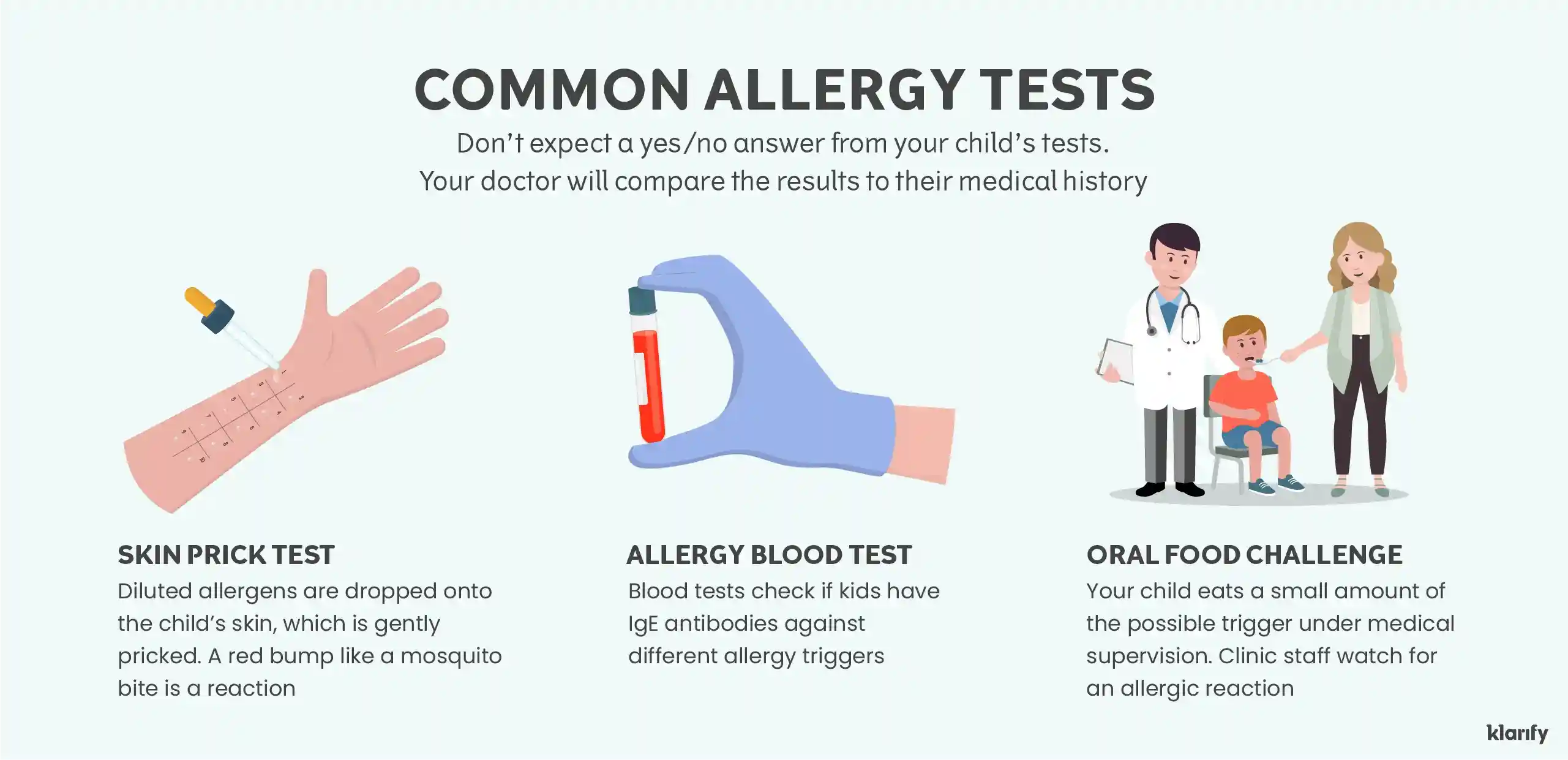
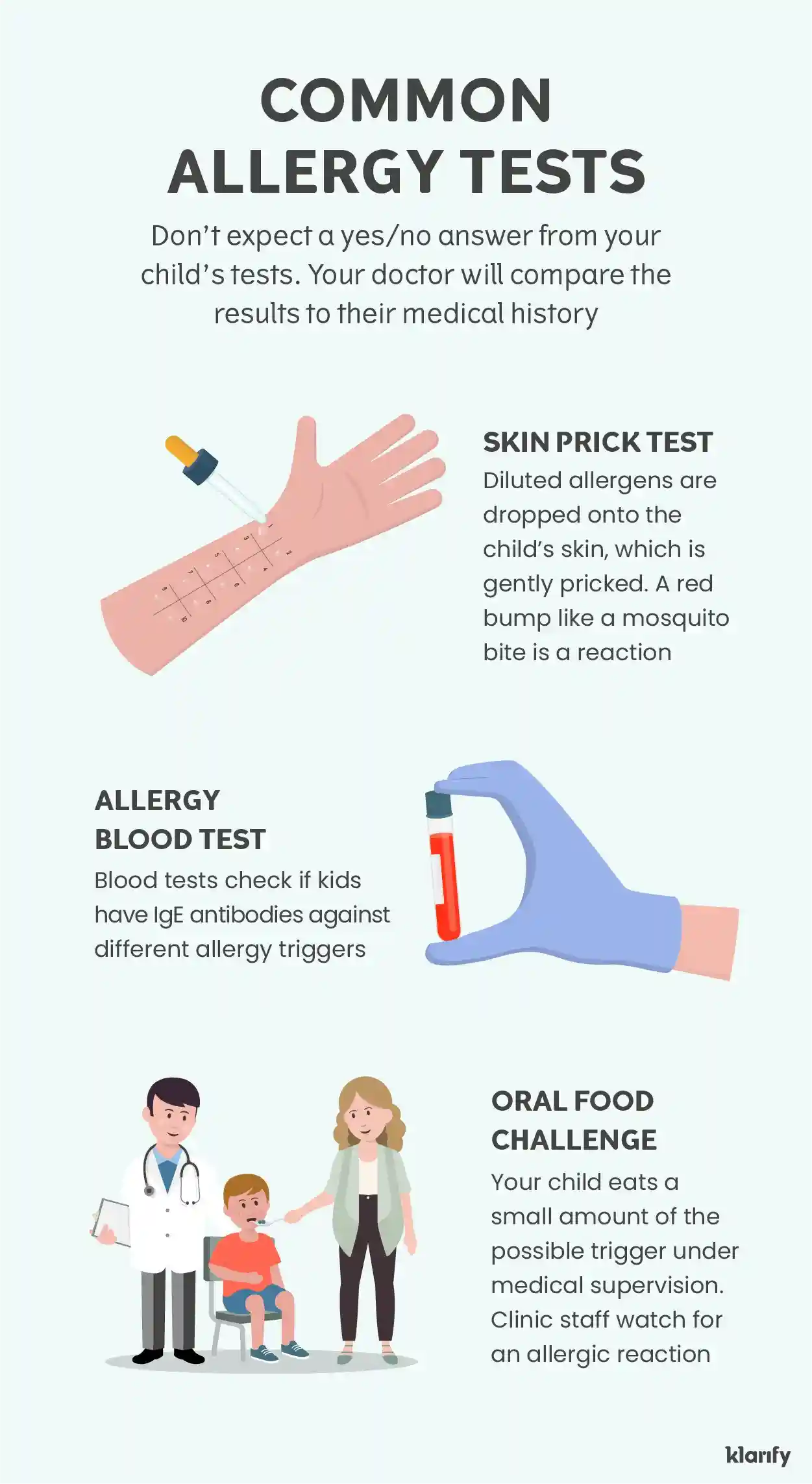
There are three main types of allergy testing for kids (and grown-ups), listed below.1,5
- Skin tests: Different types of test for different allergic conditions
- Blood tests: Useful for children with a skin condition that may interfere with a skin test
- Challenge tests: Exposes your child to their possible trigger, usually a food or medication
These tests look for evidence of allergy and the doctor will explain what the results mean.
What allergy tests look for
Allergy blood tests check for Immunoglobulin E (IgE) antibodies in your child’s blood. Skin tests and challenge tests look for a reaction that would show the antibodies are present. 1,5
The immune system creates IgE antibodies as protection against substances it considers a threat. Sometimes it gets it wrong and overreacts to substances like pollen, animal dander, dust mites, peanuts or latex. Even insect stings are generally harmless. The antibodies react to contact with that substance by triggering cells around the body to release inflammatory chemicals like histamine, causing your child’s allergy symptoms.6
What positive test results mean
A positive result shows your child is sensitised to a particular substance. It doesn’t necessarily mean they are allergic to it because allergies develop in two stages, according to the British Society for Immunology.6 That’s why you need your doctor or allergist to interpret the results.
The first contact with an allergen programs your child’s immune system. It produces IgE antibodies so their body is ready to react if they meet it again. Not everyone will develop allergy symptoms even though they carry the antibodies and test positive. This is known as being sensitised but not allergic.6
Allergy tests can generate false positive and negative results too, says the 2020 World Allergy Organization position paper, IgE Allergy Diagnostics and Other Relevant Tests.1,5
How allergy testing helps doctors make a diagnosis
Test results can help doctors make a diagnosis by narrowing down the list of possible triggers. IgE antibodies are specific to a substance or allergen.6 Test results are one piece of the puzzle and you should be ready to answer questions about your child’s symptoms, from runny nose to skin rashes and everything in between.
An allergy diary can be a useful way of recording information the doctor needs.
- When allergy symptoms started
- How long they last for
- How badly they affect your child
- Times of the year or places that make symptoms worse
- What you think might be the trigger
If you have relatives with allergies, that’s important information too because allergy tends to run in families.1
Children can get tested at any age but the number of things a tiny baby can be allergic to may be limited.5 They would usually need to encounter a substance twice to develop an allergy.6
What age can kids have allergy tests?
Allergy testing for babies is possible but IgE levels may be very low in newborns, according to the study, The Age Impact on Serum Total and Allergen-Specific IgE (Allergy, Asthma & Immunology Research, 2013).1,7 That could make diagnosis harder. The number of things a tiny baby can be allergic to is likely to be limited as it usually requires exposure to a substance at least twice to develop an allergy. 5,6
Sensitisation tends to start with eggs, cow’s milk and peanuts. Reactions may show first on your child’s skin, followed by other food allergy symptoms at weaning time. Symptoms from indoor environmental allergies to dust mites, cockroaches and pets may appear next, identified by toddler allergy tests, and then pollen.8
What kids actually feel during an allergy test and how they feel about it will vary. Talk to them beforehand so they know what to expect.

Allergy testing for kids with skin tests
Skin tests happen at the doctor’s office and there are three main types, the skin prick test, intradermal test and patch test. Your child may take antihistamines to ease their allergy symptoms and they’ll need to stop a few days before their skin testing appointment.1,5 Follow your doctor's instructions.
Skin prick test
The skin prick test tends to be the first choice of test and it can help identify allergies like pollen, dust mites, animal dander, mould or latex.1,5 Food allergy testing for kids is complex and your child may need other tests too.1 Skin prick testing is used for penicillin allergy but is less reliable for other drug allergies so a negative result may not be conclusive.9
A drop of liquid containing an allergen is placed on your child’s arm. Little children often can’t resist itching so may have the test on their back. The skin is then gently pricked and checked for a response after about 15 minutes. A small red swelling (wheal) like a mosquito bite shows your child is sensitised to that substance.5
The next step after a negative or inconclusive result may be an intradermal test.5
Intradermal test
Intradermal testing tends to be done to identify insect venom or drug allergies. It involves injecting a small amount of allergen just under the skin on your child’s arm. Interdermal testing is likely to be more uncomfortable than the skin prick type so is usually avoided in baby allergy testing and with toddlers. Your child’s doctor or the nurse will check for wheals after 15 minutes.5

Patch test
Patch tests can help identify what’s causing persistent skin inflammation (contact dermatitis). 10 For instance, children with hand eczema could be allergic to cobalt in toys or parabens in play-doh, according to the Primary Care Dermatology Society.11 It involves taping small patches carrying the allergens to your child’s back for 2-4 days.10
Usually children need to be at least 4 years old for patch testing. You’ll visit the clinic on day 1 to have the patches applied; then on day 3 to see if your child is reacting; and again on day 5 for the final assessment.10
Allergy testing for kids with blood tests
Your doctor may suggest a blood test if your child needs to keep taking medications that could interfere with a skin test. A blood test may also be appropriate if kids have particular skin conditions or have ever had a severe allergic reaction. The sample goes off to the lab so it may be quite some time before you get the allergy test results.5
Finger pricks and needles are no one’s favourite thing. Children may be able to have numbing cream or a cold spray before allergy blood tests to reduce the discomfort.12
Allergy blood test
An allergy blood test involves taking a small blood sample from your child’s arm or with a finger prick. The lab looks for specific IgE antibodies indicating sensitisation to a substance.1,5,6 Your discussion with the doctor about your child’s symptoms, plus their age and common local allergens will dictate which antibodies the test looks for.1
Component blood test
A component blood test can pinpoint which of several allergenic proteins in a substance your child is sensitised to. That can help predict the severity of their symptoms and the likelihood of their allergy progressing. For instance certain proteins in peanut, milk and egg have been linked to life-threatening reactions (anaphylaxis).13 The official name of this type of component blood testing is Precision Allergy Molecular Diagnosis (PAMD@).13

Allergy testing for kids with challenge tests
Challenge tests expose your child to their possible trigger, usually a food or drug, while the allergist or allergy nurse monitors them for any reaction.1 Kids usually need to stop taking antihistamine before a food challenge as it can mask symptoms.14 Of course, always follow your healthcare provider's instructions.
Oral food challenge (OFC)
An oral food challenge may be the next step to confirm other food allergy testing for kids or to see if a child has outgrown their hypersensitivity. It starts with eating a tiny amount of the potential trigger and the dose increases gradually.15 A child who reacts is likely to have an allergy and to need to avoid that food in future.1
Take all your child’s regular allergy medication with you, plus a change of clothes for them. Pack a comforter or special toy, if they have one, and a book or some other distraction. You may be at the clinic for several hours.15
Oral drug challenge
An oral drug challenge can help to confirm or rule out allergy in a child who gets a rash soon after taking a medication, often an antibiotic.1 The challenge starts with a small dose and builds up step by step as long as there’s no sign of a reaction. If there is, then your child will need to avoid that medication.16
Other types of tests for kids with allergic conditions
Kids with allergic asthma symptoms like a tight chest or wheezing may have a spirometry test as part of the initial physical exam. Spirometry is a breathing test that involves blowing into a tube connected to a computer. Typically, the child repeats the test after inhaling medication to open their airways. Any improvement in their breathing is another clue to guide the asthma diagnosis and treatment plan.17
The doctor or nurse will explain what’s going to happen but children may find the process a little scary. Tell them astronauts do the very same test – at zero gravity.18
The short version
Common types of allergy testing for kids include different skin tests, blood tests and challenge tests. Children may need more than one to rule allergy in or out as the cause of their symptoms.1 Your doctor or allergist will interpret the results alongside your child’s detailed clinical history and symptoms.
The whole process of allergy testing for kids may seem daunting. But it can unlock the right treatment for your child’s allergy.
People also ask
Here are some concise answers on other common topics around allergy testing for kids.
Who does allergy testing for kids?
Your GP is you first port of call if you think your child may have an allergy. They may be able to arrange the tests themselves, otherwise they’ll refer you to a specialist clinic. Your health insurance may cover private allergy consultations and testing but you would need to check the policy conditions.
How painful is allergy testing for kids?
Allergy tests can be uncomfortable for kids. Older children expect the experience to be worse than it turns out to be, while younger children are less fearful beforehand but find it more painful, according to the study Comparison of Pain during Skin-prick Testing, Immunizations, and Phlebotomy (Allergy and Asthma Proceedings, 2016).19
The Evelina children’s hospital in London recommends blowing bubbles to distract smaller children. You can ask the clinic about pain relief options.12
Are allergy tests for kids always right?
Even well-respected allergy tests for children, such as skin prick tests and specific IgE blood tests, are not always 100% accurate. Different factors can cause false positives and false negatives, as your doctor will explain. That’s why they will interpret the results alongside your child’s clinical history and symptoms.5
Klarify takes allergy science and makes it simple, and we have rigorous process for doing this. We use up-to-date and authoritative sources of information. Medical experts review our content before we share it with you. They and the klarify editorial team strive to be accurate, thorough, clear and objective at all times. Our editorial policy explains exactly how we do this.
References
1. Eigenmann PA, Atanaskovic-Markovic M, Hourihane O'B J, et al. Testing children for allergies: why, how, who and when. PAI 18 March 2013.
https://onlinelibrary.wiley.com/doi/10.1111/pai.12066
2. European Academy of Allergy and Clinical Immunology. Global atlas of allergy. Retrieved 18 November 2025.
https://eaaci-cdn-vod02-prod.azureedge.net/KnowledgeHub/education/books/Global%20Atlas%20of%20Allergy%20-%20English%20Version.pdf
3. NHS. Antihistamines. Retrieved 25 November 2025.
https://www.nhs.uk/medicines/antihistamines/
4. Scadding GK, Kariyawasam HH, Scadding G, et al. BSACI guideline for the diagnosis and management of allergic and non-allergic rhinitis (Revised Edition 2017). Clin Exp Allergy. 2017;47(7):856-889. doi:10.1111/cea.12953.
https://onlinelibrary.wiley.com/doi/epdf/10.1111/cea.12953
5. Ansotegui IJ, Melioli G, Canonica GW, et al. IgE allergy diagnostics and other relevant tests in allergy, a World Allergy Organation position paper. World Allergy Organ J. 2020 Feb 25;13(2):100080. doi: 10.1016/j.waojou.2019.100080.
https://www.ncbi.nlm.nih.gov/pmc/articles/PMC7044795/
6. British Society for Immunology. Allergy. Retrieved 26 November 2025.
https://www.immunology.org/policy-and-public-affairs/briefings-and-position-statements/allergy
7. De Amici M, Ciprandi G. The Age Impact on Serum Total and Allergen-Specific IgE. Allergy Asthma Immunol Res. 2013;5(3):170-174. doi:10.4168/aair.2013.5.3.170.
https://pmc.ncbi.nlm.nih.gov/articles/PMC3636452/
8. Thomsen SF. Epidemiology and natural history of atopic diseases. Eur Clin Respir J. 2015; 2: 10.3402/ecrj.v2.24642.
https://www.ncbi.nlm.nih.gov/pmc/articles/PMC4629767/
9. Heinzerling L, Mari A, Bergmann K-C, et al. The skin prick test – European standards. Clin Transl Allergy 3, 3 (2013).
https://ctajournal.biomedcentral.com/articles/10.1186/2045-7022-3-3
10. British Dermatological Nursing Group. Patch testing: A best practice guide. Retrieved 26 November 2025.
https://bdng.org.uk/wp-content/uploads/2017/02/FINAL130117.pdf
11. Primary Care Dermatology Society. Eczema: Contact dermatitis (including latex and rubber allergy). Retrieved 26 November 2025.
https://www.pcds.org.uk/clinical-guidance/eczema-contact-allergic-dermatitis-including-latex-and-rubber-allergy
12. Evelina London. Guy’s and St Thomas’ NHS Foundation Trust. Pain relief during blood tests. Retrieved 26 November 2025.
https://www.evelinalondon.nhs.uk/resources/patient-information/pain-relief-during-blood-tests.pdf
13. Knyziak-Mędrzycka I, Majsiak E, Cukrowska B. Allergic March in Children: The Significance of Precision Allergy Molecular Diagnosis (PAMD@). Nutrients. 2023; 15(4):978. doi.org/10.3390/nu15040978.
https://www.mdpi.com/2072-6643/15/4/978
14. Evelina London. Guy’s and St Thomas’ NHS Foundation Trust. Food challenges and supervised feeds. Retrieved 10 April 2026.
https://www.evelinalondon.nhs.uk/resources/patient-information/food-challenges-and-supervised-feeds.pdf
15. Allergy UK. Your quick guide to: Oral food challenge. Retrieved 26 November 2025.
https://www.allergyuk.org/resources/oral-food-challenge/
16. Evelina London. Guy’s and St Thomas’ NHS Foundation Trust. Suspected drug allergy investigations. Retrieved 26 November 2025.
https://www.evelinalondon.nhs.uk/resources/patient-information/suspected-drug-allergy-investigation.pdf
17. Prisk GK. Pulmonary challenges of prolonged journeys to space: taking your lungs to the moon. Med J Aust. 2019;211(6):271-276. doi:10.5694/mja2.50312.
https://pmc.ncbi.nlm.nih.gov/articles/PMC6745695/
18. NHS. Allergies. Retrieved 26 November 2025.
https://www.nhs.uk/conditions/allergies/
19. Coop CA, Forester JP. Comparison of pain during skin-prick testing, immunizations, and phlebotomy. Allergy Asthma Proc. 2016;37(5):93-97. doi:10.2500/aap.2016.37.3961.
https://pubmed.ncbi.nlm.nih.gov/27657516/
GB-NPR-2600027 April, 2026